Etching Stonehenge onto a Fallen Leaf: Preserving My Favorite Travel Memory
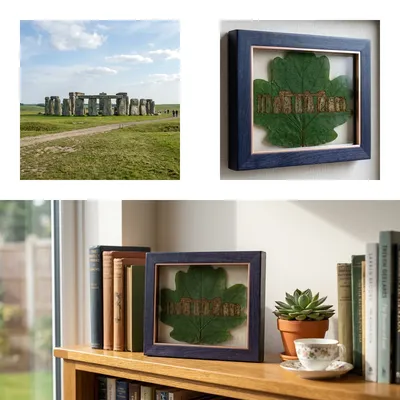
How I turned a phone photo into a delicate, backlit piece of natural art for my living room.
Three years ago, I stood on Salisbury Plain as the autumn sun dropped behind Stonehenge. The wind bit straight through my coat, but the megaliths glowed like live embers. I pulled out my phone, snapped the shot, and jammed my hands back into my pockets. For months, that photo stayed buried between grocery lists and random screenshots. It deserved better than dying inside a camera roll.
Standard canvas prints and glossy frames felt flat. I wanted a medium as raw and grounded as that freezing afternoon in Wiltshire. That led me to leaf engraving—a process that burns an exact photograph directly into the organic grid of a preserved botanical leaf.
From Digital File to Organic Art
Moving from a screen to plant tissue proved surprisingly precise. Using high-precision laser etching, the dark stone silhouettes and twilight gradients were micro-burned directly into the leaf cell structure. Rather than destroying the delicate vascular network, the laser uses the leaf's natural vein matrix as its canvas.
What separates this from a conventional paper print comes down to physical texture:
- Organic texture: Every leaf possesses a distinct vein matrix, making the structural pattern behind the Stonehenge arches entirely unique.
- Natural translucency: Backlighting illuminates the burned details, turning the image into a miniature piece of stained glass.
- Zero glare: Without a synthetic ink layer, room lights produce no surface reflections or washout.
A single personalized photo reproduction run transformed a forgotten snapshot into a tactile artifact.
Displaying the Piece
I mounted the finished leaf inside a double-glass wooden float frame on the shelf beside my coffee spot. Around 8:00 AM each morning, sunlight cuts across the room and strikes the glass from behind. Stonehenge burns a warm amber against the leaf's skeleton, pulling me right back to that quiet, freezing English morning.
It isn't passive decor; it is an immediate conversation piece. Visitors pick up the frame, hold it against the light, and try to figure out how detail that sharp lives inside something so delicate. It pulled a fading travel moment off a server and put it back in my hands.
FAQ
How fragile is a laser-etched leaf, and how should I display it safely?
Preserved leaves undergo a conditioning treatment to retain flexibility, preventing them from turning brittle. They remain delicate, however. Mounting the leaf inside a double-pane glass float frame shields it from dust and handling while allowing natural light to pass through the grain.
What kind of photo works best for a leaf engraving?
High-contrast images with clean silhouettes yield the sharpest results. The Stonehenge shot succeeded because the dark stone shapes stood in stark contrast to the bright sky. Architectural outlines, backlit portraits, and bold landscape silhouettes translate exceptionally well onto natural leaf veins.
What are the typical dimensions of a custom etched leaf art piece?
Most preserved leaves selected for photo etching measure 6 to 8 inches high by 4 to 5 inches wide. These dimensions sit comfortably on floating wall shelves, desks, or bookcases without dominating the space.
Will the etched image fade over time when exposed to sunlight?
Because laser etching carbonizes the image directly into natural plant fibers rather than depositing ink, the details will not fade like an inkjet print. To preserve the leaf's natural background pigment over the years, display it in bright ambient light rather than intense, direct midday sun.
You may also like
Contact us: support@memorieslab.co
← Back to gallery