Framing Fantasies: How a Wireframe Castle Camera Ignites Imagination in the Nursery
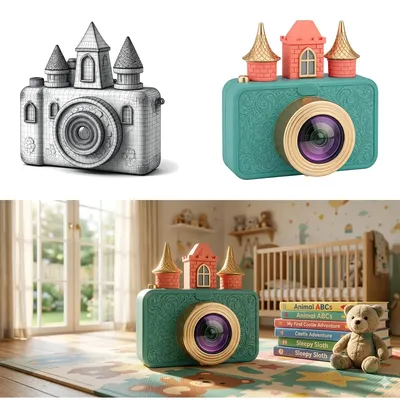
Discover the magic of a uniquely designed toy camera that transforms playtime into a creative adventure for little ones.
In the vibrant, cheerful chaos of a child's nursery, every object holds the potential for a grand adventure. But what if one particular toy, a monochromatic wireframe castle camera, isn't just an object, but a gateway to boundless imagination? This exquisitely simple yet profound toy is sparking a new kind of play, fostering creativity and an early love for observation and storytelling in the tiniest hands.
Imagine a tiny hand reaching for a camera that doesn't capture pixels, but dreams. Its minimalist wireframe design, forming the silhouette of a majestic castle, stands out in a world often dominated by flashy, multi-colored gadgets. This isn't just a toy; it's a statement piece that whispers tales of knights, dragons, and royal feasts, all waiting to be 'photographed' through the lens of a child's burgeoning imagination.
The Architectural Marvel: A Catalyst for Creative Worlds
The genius of the monochromatic wireframe castle camera lies in its deliberate simplicity. By stripping away intricate details and vibrant colors, the toy invites children to become the chief architects of their play. The wireframe castle is not just a prop; it's an open-ended suggestion. Is it a grand fortress protecting precious treasures? A whimsical dwelling for imaginary creatures? Or a towering skyscraper in a bustling city built from blocks?
This minimalist design actively encourages 'filling in the blanks.' Children are prompted to supply the colors, textures, and stories from their own minds, fostering a deeper, more personal engagement than a fully realized, prescriptive toy. The castle motif itself is a universal symbol of fantasy and adventure, instantly transporting children to worlds where anything is possible. As they peer through its 'lens,' they're not just playing; they're directing, creating, and documenting their own fantastical narratives, transforming everyday nursery items into subjects worthy of a royal portrait or an epic landscape shot.
Developing a Young Photographer's Eye: Capturing Imagined Moments
Beyond its aesthetic appeal, the wireframe castle camera serves a crucial developmental purpose: it cultivates the art of observation. While it doesn't take real pictures, the act of holding the camera, framing a subject, and 'clicking' the imaginary shutter teaches children the fundamental principles of photography and visual storytelling. They learn to look closely at their surroundings, identify interesting details, and decide what constitutes a 'picture worthy' moment.
This playful interaction subtly encourages critical thinking and a deeper connection to their environment. A pile of blankets becomes a mountain range, a stuffed animal transforms into a wild beast, and a sibling's smile is the perfect candid shot. The monochromatic nature of the camera further enhances this by encouraging focus on shape, light, and form, rather than being distracted by color. It's a foundational lesson in visual composition, laying the groundwork for an appreciation of art and photography later in life. By giving them a tool to 'capture' their world, even an imagined one, we empower them to become active observers and creators, fostering a lifelong love for exploring and documenting the beauty around them.
In a nursery filled with joyful sounds and vibrant energy, the monochromatic wireframe castle camera stands as a quiet invitation to explore, create, and imagine. It's a testament to the power of thoughtful design, proving that sometimes, the simplest toys can spark the most extraordinary adventures and cultivate the most profound creativity in a child's heart.
FAQ
Is the wireframe castle camera a functional camera that takes pictures?
No, it is designed as a toy to spark imaginative play. Its purpose is to encourage observation, creativity, and the act of 'capturing' imagined moments, rather than taking actual photographs. It's a tool for pretend play and visual storytelling.
What age range is this toy suitable for?
While specific age recommendations can vary, toys that encourage imaginative play like this are generally ideal for toddlers and preschoolers (ages 2-5). Its open-ended nature also makes it appealing to slightly older children who enjoy creative play and unique aesthetics.
Why is it designed to be monochromatic and wireframe? How does this benefit a child's development?
The monochromatic and wireframe design is intentionally minimalist. It encourages children to use their own imagination to fill in colors, textures, and details, fostering more creative and open-ended play. This simple aesthetic helps children focus on form, observation, and storytelling without overwhelming sensory input, promoting deeper engagement and cognitive development.
How does a toy camera, even an imaginary one, encourage a love for capturing the world?
By mimicking the act of photography, children learn to observe their surroundings more closely, 'frame' scenes, and mentally 'capture' moments – even if they're purely imaginary. This foundational interaction cultivates an early appreciation for visual storytelling, develops observation skills, and can spark an interest in documenting their experiences, which may later extend to real photography and other visual arts.
You may also like
Contact us: support@memorieslab.co
← Back to gallery