Rainy Day Revelation: A Lotus Leaf's Influence on Studio Design
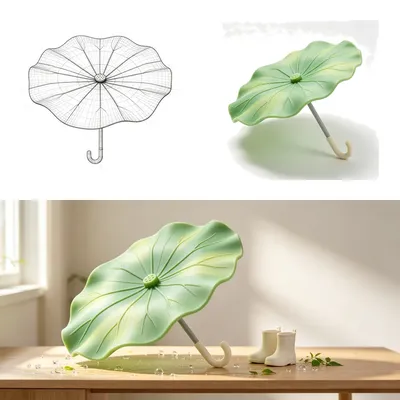
Quiet observation yielded a minimalist design marvel, tailored for the modern workspace.
From Pond to Desk: An Unexpected Design Spark
A proper rainy day. The kind that blurs the world outside into a soft gray. Staring out my studio window, coffee cooling, I watched the steady drip into a nearby pond. Even under a downpour, lotus leaves held their shape. Water beaded and rolled off, leaving them impossibly elegant, serene – like tiny, natural umbrellas.
That image stayed with me: its quiet resilience, its perfect, minimalist form. It sparked a question: how do you translate such calm, organic inspiration into a busy, modern creative studio? Not literally, of course – no wet leaves. But its essence. The idea of protection, of beauty found in simplicity.
From that, the wireframe lotus leaf umbrella concept emerged. I wanted something that echoed that natural grace, yet fit seamlessly into a sleek, contemporary space. Something light, airy, and considered.
Crafting Calm: The Design Journey
Translating that organic shape into a minimalist, structural piece presented an engaging challenge. We began with countless sketches, aiming to capture the precise curve and subtle tilt of a lotus leaf. The aim: an umbrella form, stripped of bulk, revealing only an elegant skeletal structure. For initial prototypes, FDM printing proved invaluable. It allowed rapid testing of angles and proportions, revealing how light interacted with the open frame. We iterated swiftly, fine-tuning tiny adjustments to perfect the silhouette.
Next, the finer details. For delicate ribbing and the subtle curve mimicking a leaf's surface tension, high-resolution resin print delivered essential precision. The resulting crispness and clean lines demonstrate how modern tools refine natural concepts.
This entire journey, from a rainy day observation to a tangible object, underscores the power of custom product design. This wasn't about an off-the-shelf solution; it was about translating specific, personal inspiration into a unique piece. Early iterations depended entirely on 3D printing to refine the wireframe. Achieving this level of precision and iterative flexibility for such a complex piece isn't possible otherwise.
Now, it sits on my desk: a small, elegant reminder. It catches light distinctively throughout the day. A serene inspiration, born from a rainy afternoon and a simple lotus leaf. It quietly enhances the studio's atmosphere, a small oasis of calm amid deadlines and new concepts.
FAQ
Is this wireframe lotus leaf umbrella functional, or is it purely decorative?
This specific wireframe lotus leaf umbrella functions as a decorative art piece. Its minimalist, skeletal structure captures the lotus leaf's aesthetic elegance, offering serene inspiration for a creative studio, not protection from rain. The focus is purely on its calm, organic form.
What materials are typically used for a piece like this, especially given the mention of 3D printing?
For prototypes, we typically use durable plastics suited for <strong>FDM printing</strong>, allowing for rapid, cost-effective shape testing. For the final, refined art piece, a high-quality <strong>resin print</strong> is employed. This provides a smoother finish and superior detail for the delicate wireframe and 'veining' of the leaf structure. Material selection depends on the desired finish and structural strength.
Can I commission a similar custom product design if I have a different nature-inspired idea for my studio?
Absolutely. That's precisely the purpose of <strong>custom product design</strong>. If you envision another natural element or concept translated into a unique art piece for your space, we can guide the design process. From initial sketches through prototyping with <strong>3D printing</strong> and finishing with a precise <strong>resin print</strong>, we actualize your specific vision, just as we did with the lotus leaf umbrella.
What are the typical dimensions of such a piece, and can they be customized?
Dimensions for a desktop piece like this typically aim for visual impact without dominating your workspace. Diameters usually range from 8 to 12 inches. Given their creation via <strong>3D printing</strong> and classification under <strong>custom product design</strong>, dimensions are highly customizable. We can discuss your specific space requirements and scale the design accordingly.
You may also like
Contact us: support@memorieslab.co
← Back to gallery